

One of the most common questions I hear from individuals approaching or already in retirement is, “How much can I safely withdraw from my portfolio without running out of money?”
When it comes to retirement spending, I believe retirees often face two competing concerns. The first is underspending—being overly cautious, leaving more money behind than intended, and potentially missing opportunities to enjoy retirement. The second is overspending—withdrawing too much, depleting their savings prematurely, and potentially outliving their portfolio.
Finding the right balance between these two concerns is one of the most important aspects of retirement income planning.
For decades, some financial advisors have relied on the 4% rule as a starting point. While this rule provides a useful guideline, I believe it can be overly conservative and doesn’t account for each retiree’s unique circumstances.
In many situations, retirees can withdraw more than the traditional 4% rule suggests, provided they’re willing to adjust along the way.
At Snyder Asset Management, we believe the Guardrails Method is one of the most effective strategies for addressing both concerns—helping retirees enjoy their money while maintaining a disciplined approach to preserving their portfolio.
Key Takeaways
- Retirees face two competing risks: underspending and overspending. A successful retirement income strategy should help individuals enjoy their savings without taking unnecessary risks of running out of money.
- The 4% rule is a starting point, not a personalized retirement spending strategy. Depending on your age, financial circumstances, and goals, you may be able to withdraw more.
- Focus on dollars, not just percentages. The more important question is how much annual income your portfolio can provide throughout retirement.
- The Guardrails Method provides a more flexible approach. It establishes guidelines for when retirees can increase spending and when they should temporarily reduce withdrawals.
- Your retirement spending strategy should evolve. Changes in market performance, Social Security income, healthcare needs, and personal goals should influence how much you withdraw.
1. Understanding the 4% Rule
The 4% rule is one of the most widely recognized guidelines in retirement planning.
The concept is relatively straightforward. In your first year of retirement, you withdraw 4% of your portfolio. In subsequent years, you adjust that initial dollar amount for inflation.
For example, someone retiring with a $2 million portfolio would initially withdraw $80,000 annually. Assuming 3% inflation, their withdrawal would increase to $82,400 the following year, regardless of how the portfolio performed.
The original research behind this approach examined historical market returns and was designed to help retirees avoid exhausting their portfolios over approximately 30 years.
However, the 4% rule doesn’t account for many factors that can influence how much an individual can comfortably spend.
Consider two retirees, both with $2 million portfolios. One is 60 years old, wants to leave a substantial inheritance, and anticipates significant future healthcare expenses. The other is 75, has long-term care insurance, and has no particular desire to leave an inheritance.
Should both individuals withdraw the same percentage of their portfolios?
I don’t believe so.
2. The Guardrails Method: A More Dynamic Approach
While withdrawal percentages provide a useful starting point, most retirees aren’t concerned with percentages. They want to know how much money they can actually spend each year.
This is where the Guardrails Method becomes particularly valuable.
Rather than focusing on maintaining a specific withdrawal percentage, we establish an annual dollar amount that can increase or decrease based on investment performance and changes in the client’s financial circumstances.
The strategy incorporates historical market returns, assumptions about future investment performance, and each client’s financial circumstances to determine an appropriate initial spending amount.
Historical returns provide valuable perspective. For example, someone retiring around 2000 experienced a very different investment environment than someone retiring in 2010.
The S&P 500 generated disappointing returns during the decade following 2000 (widely referred to as the lost decade, when returns were approximately 0%), while the subsequent decade (2010–2019) produced a cumulative total return of approximately 257%, or 13.6% annually, including reinvested dividends.
Of course, we don’t know in advance which market environment a retiree will experience. By examining a range of potential outcomes, we can develop a spending strategy that accounts for this uncertainty.
The real advantage of guardrails, however, is what happens after retirement begins.
Here’s how it works:
We establish an initial annual withdrawal amount along with two boundaries: an upper guardrail and a lower guardrail.
- When markets perform well: If portfolio growth reaches the upper guardrail, we recommend increasing the client’s annual withdrawals, giving them the option to enjoy additional retirement income.
- When markets perform poorly: If portfolio declines cause the lower guardrail to be reached, we recommend temporarily reducing withdrawals to help preserve the portfolio.
- When the portfolio remains between the guardrails: Spending generally remains unchanged, but the guardrails themselves continue to evolve. Factors such as inflation and a shorter remaining retirement horizon can influence how much a client can afford to spend. As retirees age, they may have opportunities to increase spending even without significant portfolio growth.
For example, a retiree with a $4.695 million portfolio might initially withdraw $252,000 annually, equivalent to 5.4%.
If their portfolio grows to $5.3 million, the strategy supports increasing annual withdrawals to $284,000.
If the portfolio drops to $3.101 million, the strategy calls for reducing annual income to $239,000.
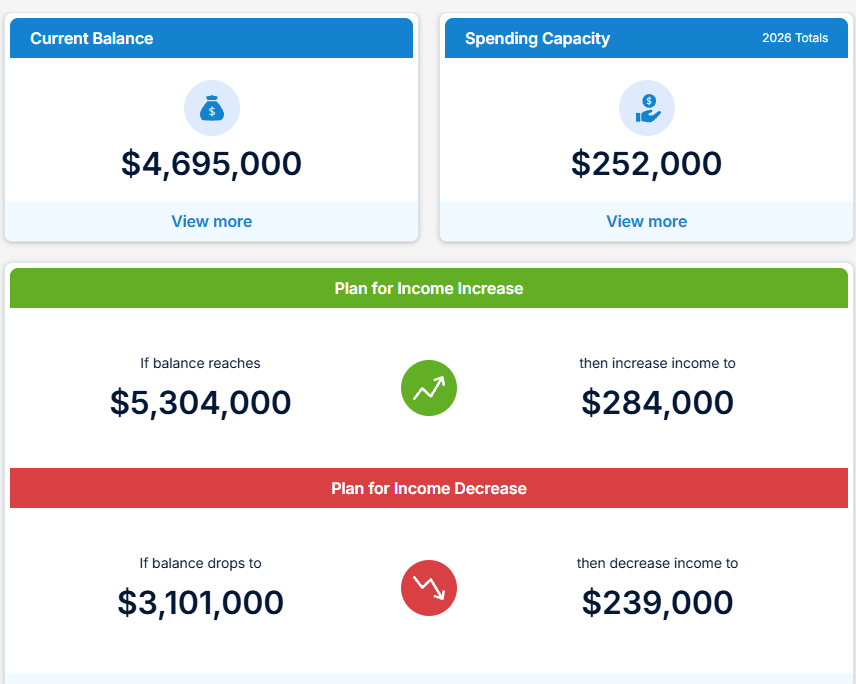
This is how guardrails help address both underspending and overspending. When financial circumstances improve, retirees may be able to spend more and enjoy their retirement without unnecessarily accumulating wealth they don’t intend to leave behind. When circumstances deteriorate, the strategy provides guidelines for reducing spending before withdrawals place too much pressure on the portfolio.
The objective isn’t to maintain a particular withdrawal percentage. It’s to determine how much a retiree can reasonably afford to spend while establishing a disciplined process for making adjustments.
In my experience, this flexibility can let some retirees begin retirement with more annual income than the traditional 4% rule would suggest, provided they’re comfortable adjusting if markets don’t cooperate.
3. Your Personal Circumstances Matter
Another important consideration is that retirement spending should never be based exclusively on investment returns.
Your age, financial goals, and anticipated expenses all play an important role.
Consider two examples.
Retiree A: Age 75
This individual has a $2 million portfolio, long-term care insurance, and no significant desire to leave an inheritance.
From a planning standpoint, we might assume a retirement horizon of approximately 15–20 years.
Because this retiree has a shorter expected withdrawal period, some protection against long-term care expenses, and a willingness to spend down principal, a higher initial withdrawal amount may be appropriate.
Retiree B: Age 60
This individual also has a $2 million portfolio but hopes to leave a meaningful inheritance to their children, doesn’t have long-term care insurance, and may need their assets to last 35 years or longer.
In this situation, I would generally recommend a more cautious initial spending strategy.
Although both retirees have identical portfolio values, their financial circumstances and objectives are very different.
That’s why I believe applying the same 4% withdrawal rule to everyone is too simplistic.
4. Accounting for Social Security and Other Future Income
One frequently overlooked aspect of retirement spending is that portfolio withdrawals don’t necessarily need to remain consistent throughout retirement.
Consider someone who retires at age 60 but plans to delay collecting Social Security until age 70.
For the first 10 years of retirement, their portfolio may need to provide most or all of their income.
As a result, they may need to withdraw a larger dollar amount from their portfolio during those earlier years.
Once Social Security begins, however, the amount they need to withdraw from their portfolio may decline substantially.
For example, suppose a retiree needs $100,000 annually to cover expenses. Before collecting Social Security, their portfolio may need to provide the entire $100,000.
If Social Security eventually provides $40,000 annually, the portfolio may only need to provide the remaining $60,000, assuming spending remains unchanged.
A well-designed retirement income strategy should account for these changes rather than assume the same withdrawal amount will apply every year.
This is another reason we favor a dynamic approach. We can coordinate portfolio withdrawals with Social Security, pensions, future expenses, and other expected income changes.
Final Thoughts
The 4% rule has been a useful guideline for retirement planning, but I don’t believe it should dictate how much every retiree spends.
Some individuals may need to withdraw less, while others may comfortably spend considerably more, depending on their circumstances and willingness to make adjustments.
Retirement planning isn’t just about avoiding the risk of running out of money. It’s also about avoiding the regret of not enjoying the money you’ve worked so hard to accumulate.
At Snyder Asset Management, we believe the Guardrails Method offers an effective way to balance these competing concerns. It gives retirees a disciplined framework to spend more when their circumstances allow and adjust when necessary.
The greatest advantage of a dynamic retirement income strategy is that it adjusts not only to changes in the markets, but also to changes in your life.